

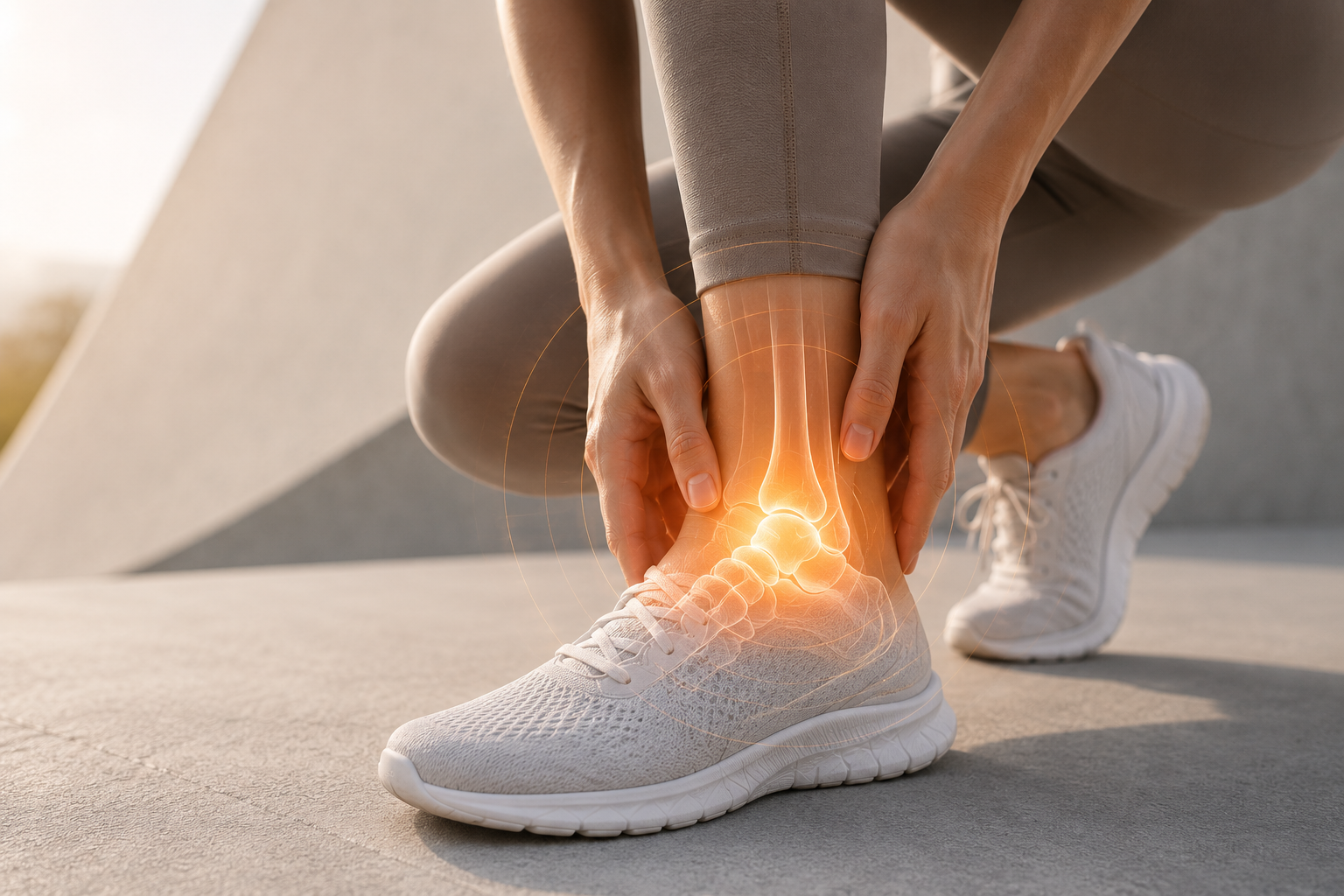
Ankle Recovery
You Thought It Was “Just a Rolled Ankle”
But for Many People, the Ankle Never Fully Returns to Its Natural Movement Rhythm
Almost everyone has experienced an ankle sprain at some point.
Missing a step downstairs.
Landing awkwardly during sports.
Rolling the ankle while running.
Or simply stepping the wrong way during everyday movement.
At first, most people assume:
“A few days of rest should take care of it.”
As the discomfort fades, life quickly returns to normal.
Work.
Exercise.
Travel.
Daily movement.
But months later, many people begin noticing something unexpected.
The ankle seems to tire more easily.
Uneven surfaces feel less stable.
Long periods of standing create heaviness and fatigue.
Movement confidence gradually decreases.
Many people assume this is simply part of getting older.
Or that the ankle is “just a little weaker now.”
But in reality, the issue may not be the original injury itself.
It may be that the ankle never fully regained its natural movement rhythm.
Why the Ankle Accumulates Stress So Easily
The ankle is one of the most dynamic and hardest-working joints in the body.
It serves as the body's primary connection to the ground.
Helping transfer force between:
- The feet
- The calf muscles
- The knees
- The hips
- The rest of the body
Every step relies on the ankle to:
- Absorb impact
- Maintain balance
- Adapt to changing surfaces
- Control direction changes
- Support lower-body stability
Whether during:
- Walking
- Running
- Strength training
- Court sports
- Long hours of standing
- Extended travel
The ankle is constantly working.
The challenge is simple:
The ankle absorbs thousands of movement demands every day — but most people rarely think about helping it recover.
This becomes especially important when:
- Calf muscles become tight
- Foot stability decreases
- Fatigue accumulates
- Recovery falls behind daily demands
When these factors build up, stress may gradually concentrate around the ankle and surrounding tissues.
Over time, movement may begin feeling less efficient, less stable, and less natural.
The Biggest Problem After a Sprain Is Often Not Pain
It Is the Loss of Stability and Movement Confidence
One of the biggest misconceptions about ankle recovery is that once pain disappears, recovery is complete.
But many people continue experiencing:
- Repeated ankle rolling
- Protective walking patterns
- Hesitation during sports
- Tight calves
- Faster fatigue during activity
Because ankle sprains are rarely only about a single ligament.
They may gradually influence:
- Muscle activation
- Balance awareness
- Neuromuscular response
- Lower-body coordination
As the body adapts, movement patterns may slowly change.
Without realizing it, people may begin compensating through:
- The calves
- The knees
- The feet
- The hips
Over time, overall movement efficiency may gradually decline.
The ankle may no longer feel painful.
But it may not feel fully reliable either.
Ankle Instability Is Often a Recovery Problem
Not Just an Injury Problem
Many people assume ankle issues begin and end with a sprain.
But in many cases, the challenge is not simply the injury itself.
It is how well the body restores movement quality afterward.
Standing.
Walking.
Training.
Commuting.
Traveling.
The ankle continues managing movement demands every day.
When recovery falls behind, small movement inefficiencies may begin to accumulate.
Balance may become less efficient.
Fatigue may appear sooner.
Stability may gradually decline.
Over time, these changes may affect the entire lower body.
That is why recovery is not only about resting.
It is about helping recovery happen continuously.
Modern Ankle Problems Often Begin Long Before Pain Appears
One of the biggest modern challenges is not lack of activity.
It is lack of recovery.
Many people spend their days:
- Standing for long hours
- Walking extensively
- Training after work
- Traveling frequently
- Remaining active despite accumulated fatigue
The ankles rarely receive an opportunity to fully recover.
Combined with:
- Unsupportive footwear
- Limited mobility work
- Repetitive movement patterns
- Ongoing fatigue accumulation
The ankle may remain under constant movement load.
Which is why many ankle issues are not caused by one major event.
But rather:
Small amounts of repeated stress over time.
The VITAL SALVEO Philosophy
Recovery Should Keep Moving
At VITAL SALVEO, we believe recovery should not only happen during rest.
It should continue throughout everyday movement.
Modern life rarely allows complete recovery breaks.
Most people move continuously throughout the day:
- Standing
- Walking
- Commuting
- Traveling
- Training
The body constantly adapts to these demands.
Recovery support should adapt alongside it.
That is why we redefine recovery wear as:
Active Energy Management Gear
Designed to support recovery through movement, not separate from it.
Supporting Recovery Through Everyday Wear
At the core of VITAL SALVEO is our:
3D Bio-Dynamic Infrared Recovery Technology
This technology combines:
- Graphene fibers
- Germanium technology
- Seamless Dynamic Compression
- Ergonomic 3D Dynamic Structures
When the fabric reaches approximately 32°C against the skin, it activates our Thermal Trigger System.
Using natural body heat, the fabric is designed to continuously generate infrared energy.
This process helps create a photobiomodulation-inspired environment that supports:
- Circulation
- Muscle relaxation
- Everyday comfort
- Recovery efficiency
No batteries.
No external power.
No complicated setup.
Just recovery support integrated naturally into daily movement.
Why “Flow, Not Restriction” Matters
When ankle discomfort appears, many people immediately seek rigid support.
While immobilization may be useful in certain situations, excessive restriction can sometimes interfere with natural movement patterns.
This is especially important for the ankle — a joint designed for continuous adaptation and dynamic movement.
That is why VITAL SALVEO believes in:
Flow, Not Restriction.
Through our 3D Bio-Dynamic Structure, we help balance:
- Stability
- Freedom of movement
- Breathability
- Natural circulation flow
Because the best recovery should not stop movement.
It should help movement feel smoother and more natural.
Ankle Health Is Movement Health
Most people only begin paying attention to their ankles after instability appears.
But ankle wellness is closely connected to:
- Walking rhythm
- Lower-body stability
- Movement efficiency
- Fatigue management
- Everyday mobility
True recovery is not something that begins only after discomfort develops.
It is something that should support the body every day.
Because long-term movement quality is not built by avoiding movement.
It is built by helping the body recover from movement more effectively.
VITAL SALVEO
Wake Up Your Body's Potential.



Share:
Your Hands Never Really Rest
Why Do Knees Always Seem to Get Fatigued the Easiest?